 |
|
|
|
|  | 1803 Large Cent - Sm Date, Sm Fraction - Vf details $199.00 | |
 | ☆Large Cent Us Penny Cull Braided Coronet☆ Draped Bust Classic Estate 1793-1858☆ $8.88 | |
|
|  | 1840 Large Date N-10 Braided Hair Large Cent Almost Uncirculated Au+ Coin #15858 $245.00 | |
 | 1855 N-4 Cuds Braided Hair Large Cent Almost Uncirculated Au Coin #21840 $149.95 | |
|
|  | New Listing1846 Braided Hair Large Cent N-6 *Small Date* 1c Ngc Ms61 Bn $39.99 | |
 | 1835 Matron Head Large 8 Us Copper Large Cent 1C $275.00 | |
|
|  | 1855 Braided Hair Knob On Ear Us Copper Large Cent 1C Ex Grellman $90.00 | |
 | 1849 Braided Hair Us Copper Large Cent 1C N-2 vLds $75.00 | |
|
|  | Certificate of Authenticity 1740 New York Penny Colonial Copper Cent Gelderland $68.00 | |
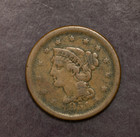 | 1851 Braided Hair Large Cent Vg Fine Lot 1527 $19.95 | |
|
|  | 1851 Braided Hair Large Cent Details Exact Coin PetetheGreek 729 $16.97 | |
 | 1852 Braided Hair Large Cent Vg Fine Details Lot 1528 $17.95 | |
|
|  | Early date 1660 New York Penny Colonial Copper Cent Campen Mint Certificate of $99.00 | |
 | 1818 Large Cent Great Deals From The Executive Coin Company $40.00 | |
|
|  | 1850 V.G. Us Large Cent V.G. Pre-Civil War - Only $17.00 And Free Shipping !✨ $17.00 | |
 | 1832 1c Coronet Head Large Cent. Attractive Circulated Details, Corroded $30.00 | |
|
|  | New Listing1851 Vf Braided Hair Liberty Head Large Cent, Nice Lower Priced Coin to collect $29.95 | |
 | 1852 Braided Hair Head Large Cent 1c Anacs Vf35 Details #160 Very Fine Ecc&C Inc $44.99 | |
|
|  | Early date 1717 New York Penny Colonial Copper Cent Friesland Mint Certificate $58.00 | |
 | New Listing✓ 1856 Braided Hair Large Cent, Slanted 5 $12.92 | |
|
|  | New Listing1851 Philadelphia Mint Copper Braided Hair Large Cent $18.00 | |
 | 1855 Braided Hair Large Cent Penny, Upright 5's, Fine/Vf Details $32.54 | |
|
|  | 1832 Coronet Head Large Cent, Medium Letters, N-2 $49.95 | |
 | 1825 Coronet Large Cent Ag+ Nice Chocolate Brown! Only $17.95 !✨ $17.95 | |
|
|  | New Listing1851 Braided Hair Large Cent- Fine/Vf Details $11.36 | |
 | New Listing1827 Coronet Head Large Cent, N-11 $20.00 | |
|
| 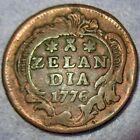 | 1776 Magic Keydate! Date of Independence! Colonial New York Penny Zeeland Coa $199.00 | |
 | 1831 Matron Head Medium Letters Us Copper Large Cent 1C N-11 Cud $85.00 | |
|
|  | 1854 Braided Hair Large Cent Z3330 $36.00 | |
 | Early date 1634 New York Penny Colonial Copper Cent Utrecht Mint Certificate of $77.00 | |
|
|  | New Listing1840 Small Date! Large Cent - Full Liberty - Pitted Cheap! Only $6.00 !✨ $6.00 | |
 | 1848 Braided Hair Large Cent Z6924 $38.00 | |
|
|  | 1829 Large Letters Large Cent Almost Uncirculated Au Coin, Corrosion #13232 $195.00 | |
 | 1842 Large Date Braided Hair Large Cent Almost Uncirculated Au Coin #15860 $195.00 | |
|
|  | 1856 Braided Hair Large Cent Almost Uncirculated Au Coin #20074 $119.95 | |
 | New Listing1845 Braided Hair Large Cent Circulated Details Old Us Coin $8.99 | |
|
| 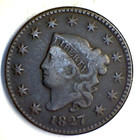 | New Listing1827 Large Cents $44.99 | |
 | 1776 Magic Keydate! Date of Independence! Colonial New York Penny Gelderland Cer $199.00 | |
|
|  | 1844 Large Cent * Braided Hair * Free Shipping $20.00 | |
 | 1838 N-11, 13 R-2 Coronet Head Large Cent Almost Uncirculated Au Coin #15080 $155.00 | |
|
|  | New Listing✓ 1827 Coronet Matron Large Cent $18.27 | |
 | Early date 1716 New York Penny Colonial Copper Cent West Frisia Mint Certificate $38.00 | |
|
|  | 1851 100% Original Chocolate Brown Large Cent! Only $38.00 !⭐ $38.00 | |
 | 1843 Braided Mature Head Us Copper Large Cent 1C $80.00 | |
|
|  | 1855 Braided Hair United States Large One Cent Upright 55 Gem Uncirculated L@K $275.00 | |
 | New Listing1803 Icg Vf20 Details Draped Bust Large Cent $225.00 | |
|
|  | 1853 Braided Hair Copper Large Cent 1C Pcgs Vf Detail - Rim Damage $35.00 | |
 | 1852 Braided Hair Large Cent Penny, Vg/Fine Details $11.54 | |
|
|  | 1852 Braided Hair Large Cent $29.00 | |
 | 1812 Classic Head Large Cent, Large Date, S-289, Good+ Condition, C7572 $199.95 | |
|
| 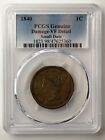 | 1840 Braided Hair Large Cent Pcgs Vf Details Small Date $51.00 | |
 | 1827 Large Cent Vf Uncertified #240 $204.00 | |
|
|  | 1851 Braided Hair Large Cent Type Coin Xf 8681S $49.00 | |
 | 1841 Large Cent High Grade 1841 Small Date Braided Hair Cent Type Coin $250.00 | |
|
|  | 1838 Matron Head Large Cent $18.00 | |
 | Certificate of Authenticity 1780 Colonial New York Penny Copper Cent Hollandia M $66.00 | |
|
|  | New Listing1850 Braided Hair Large Cent Fine+ (F+) $35.95 | |
 | 1842 Braided Hair Us Copper Large Cent 1C $85.00 | |
|
| Click to see more Large Cents items at www.ebay.com
Prices current as of last update, 05/21/25 11:29am.
|
|
|






 Home
Home 2, 3 & 20 Cents
 Braided Hair (1840-57)
